What Do We Believe Happened?
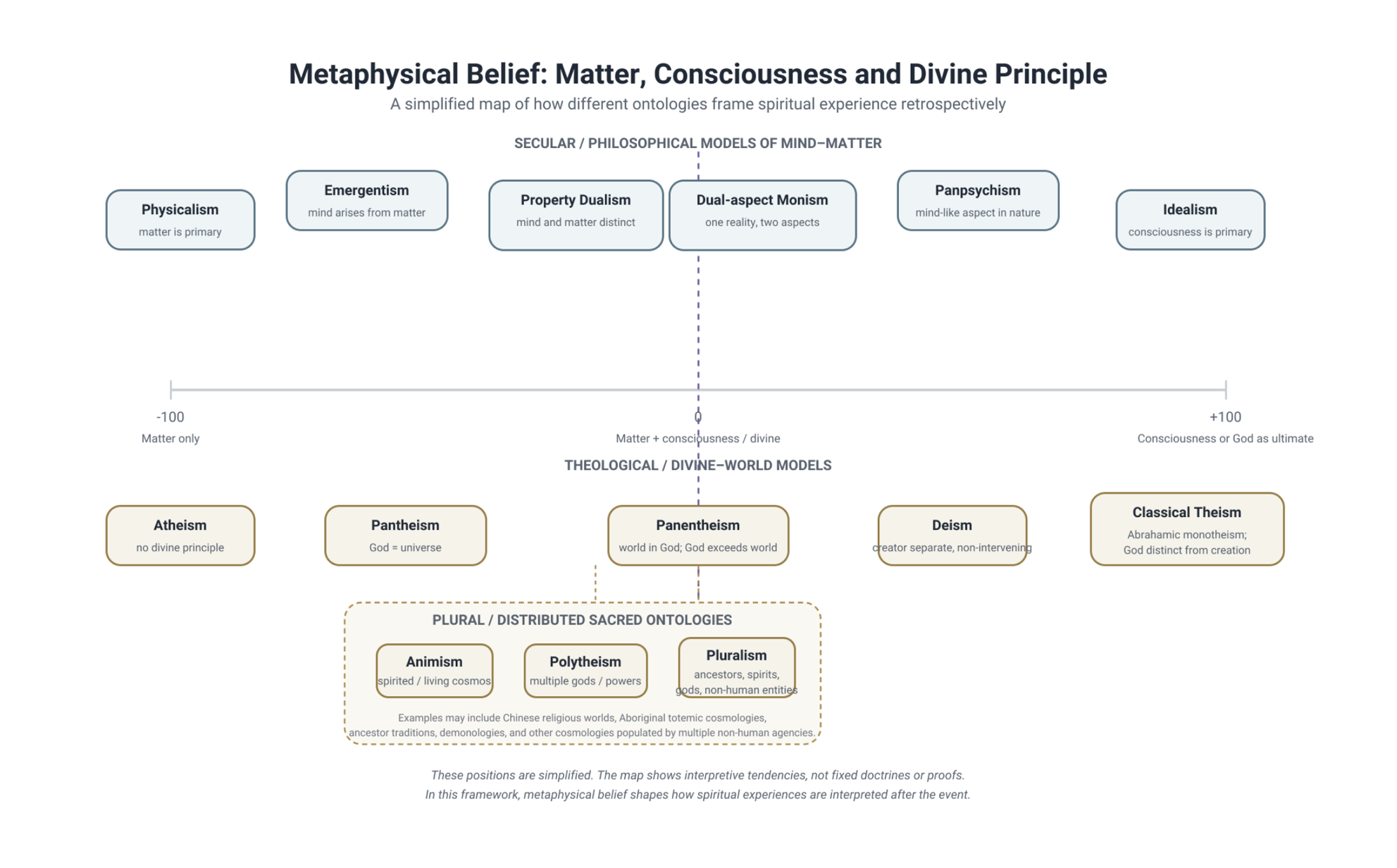
Spiritual experiences are often followed by interpretation. A person may describe the same kind of experience as an encounter with God, universal consciousness, energy, nature, the psyche, the brain, ancestors, or simply something they cannot explain. These interpretations are not interchangeable. They reflect different assumptions about what exists and what reality is made of.
This section maps those assumptions without deciding which is ultimately true. Its purpose is not to persuade the reader towards a particular metaphysics, but to make metaphysical language more precise, to show where positions overlap or diverge, and to make visible the real-life consequences of beliefs about reality, consciousness, personhood and death.
Experience tells us what happened phenomenologically. Metaphysics begins when we ask what we think the experience says about reality.
-
TEXT
-
Item description
-
Item description
-
Item description
-
Item description
| Field | Question | Examples |
|---|---|---|
| Metaphysics / ontology | What exists, and what is reality fundamentally like? | Matter, mind, God, consciousness, spirits, processes, relations, one reality or many. |
| Theology | Is ultimate reality divine, and if so what is the divine like? | Theism, deism, pantheism, panentheism, polytheism. |
| Philosophy of mind | What are mind and consciousness, and how do they relate to matter and brain? | Physicalism, dualism, idealism, panpsychism, cosmopsychism, neutral monism. |
| Epistemology | How can we know any of this, and how certain should we be? | Agnosticism, rationalism, empiricism, revelation, scientific method, plural ways of knowing. |
| Interpretive theory | How should spiritual or mystical experiences be understood across cultures? | Perennialism, constructivism/contextualism, participatory pluralism, naturalism. |
Important: atheism and agnosticism are not complete ontologies. Atheism concerns belief in God or gods; agnosticism concerns knowledge, certainty or suspended judgement. Scientism is an epistemological stance. Perennialism is an interpretive theory. A person can therefore be, for example, atheist and idealist, agnostic and physicalist, or non-theistic and panpsychist.
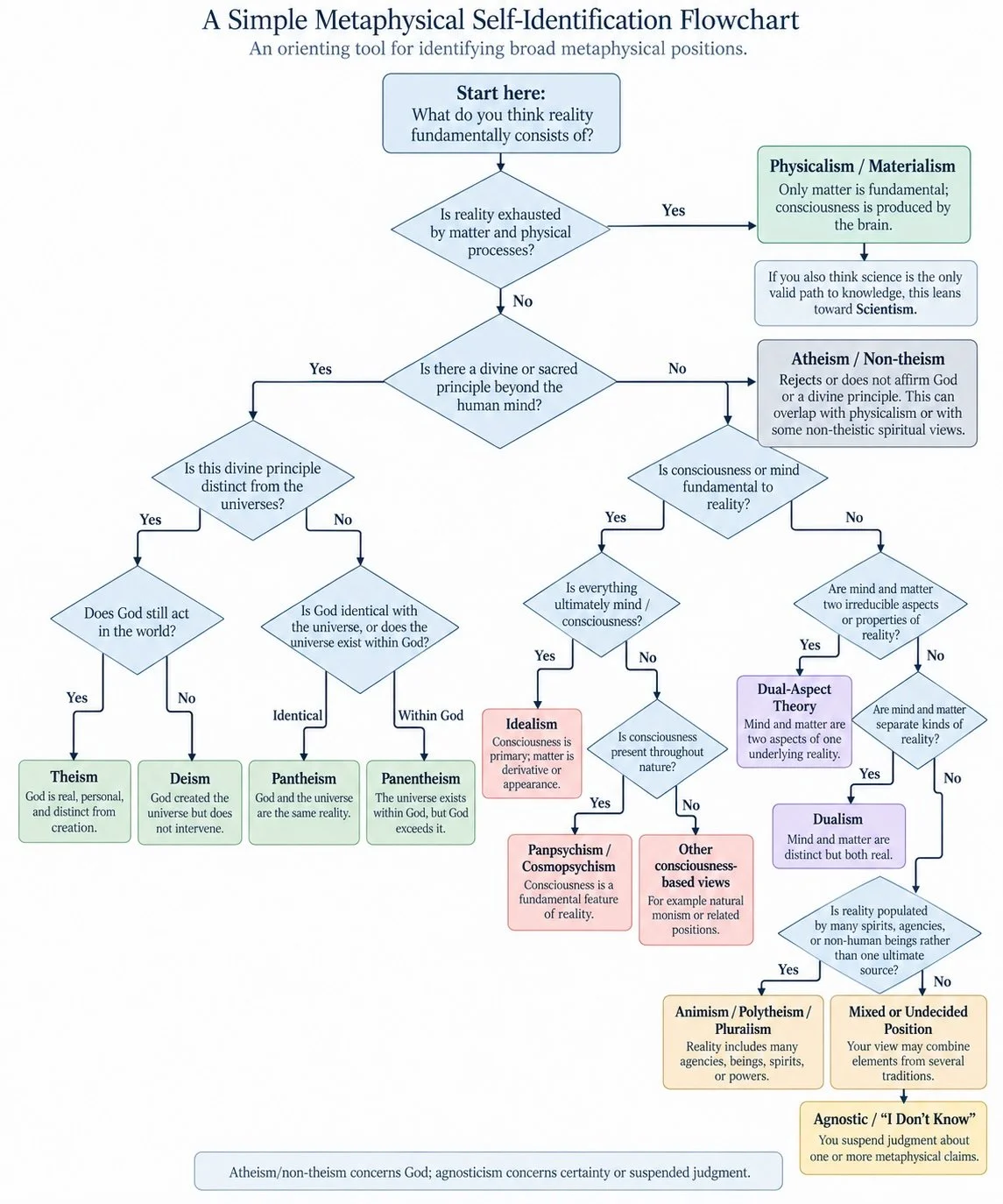
God, consciousness, energy and force are not synonyms
Consciousness, deity and metaphysical interpretation
What happens when we die?
Metaphysical beliefs become especially concrete around death. The question is not only how people prepare psychologically for mortality, but what they think happens to the person after death and whether conduct in life affects post-mortem destiny.
Ontology asks what a human being is. Eschatology asks what happens at death and beyond it. Soteriology asks whether there is something from which we must be saved, liberated or released. Ethics asks whether conduct in life affects ultimate destiny.
Agency, free will, fate and responsibility
Metaphysical systems also imply different accounts of human agency. The question is not only what exists, or what happens after death, but how free a person is within reality. Are human beings genuinely able to choose? Are they shaped by divine providence, fate, karma, grace, conditioning, biology, social structure, unconscious drives or liberation from illusion?
This matters because beliefs about agency shape guilt, sin, responsibility, moral effort, suffering, salvation, therapy and spiritual practice. A healthy spiritual path should not use metaphysical claims about destiny, karma, obedience or divine will to weaken agency. This links directly to Card 6, where the practical question becomes whether spirituality increases discernment, autonomy and responsibility or makes people more passive, submissive and manipulable.
Why metaphysics matters in real life
Metaphysics may be uncertain, but its consequences are concrete.
Beliefs about what exists shape the interpretation of experience, who is granted authority, what rituals are required, how ethics is justified, how societies organise hierarchy, and how people understand death, nature and the self.
My epistemological position
My approach is methodologically agnostic, phenomenological, pragmatic, functional and non-reductive.
I do not begin by assuming that spiritual experiences prove a supernatural or divine reality. Nor do I begin by reducing them to pathology, fantasy, delusion or brain error. Competing ontologies are treated as objects of enquiry rather than premises of the framework.
Human beings have developed multiple sophisticated and internally coherent metaphysical systems, none of which I believe can presently be established conclusively as the true ontology of reality. Intellectual rigour therefore requires me to distinguish the limits of one worldview from evidence for another.
I take spiritual experience seriously without requiring metaphysical certainty.
Download button: Concepts, Citation Guide and Further Reading.